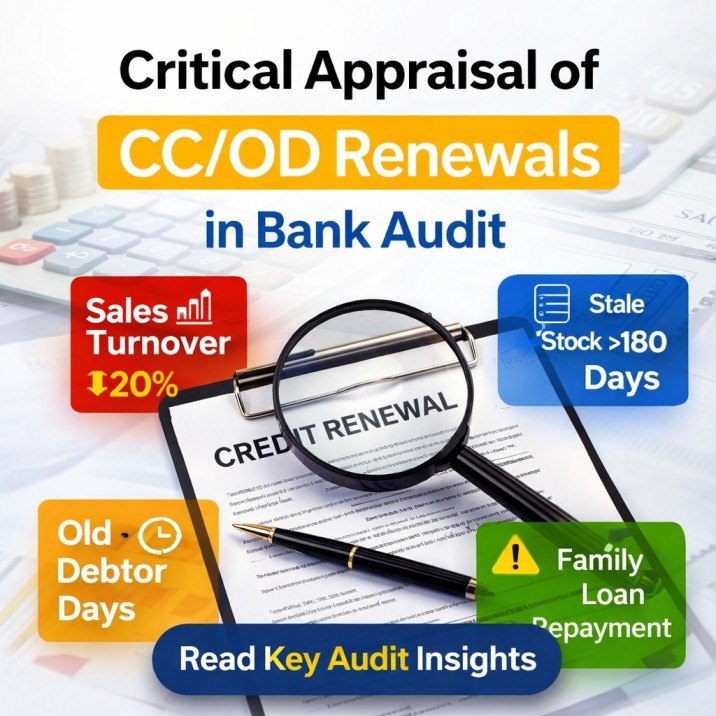
Critical Appraisal of CC/OD Renewals in Bank Audit: A Practical Guide

CA Parikshit Bhadade

3/5/20265 min read

1. The Paradigm Shift: Verification Over Recording

In the landscape of senior credit risk management, the renewal of a Cash Credit (CC) or Overdraft (OD) facility is not a clerical formality; it is a strategic re-validation of the bank’s exposure. An auditor must transition from a "checklist-based" mindset—merely confirming the presence of documents—to a "critical appraisal" methodology. The objective is to look through the paperwork to validate the underlying economic reality of the borrower’s business. If the documentation does not reflect the operational health of the entity, the credit decision is fundamentally flawed.

A sharp distinction must be maintained between the Sanction and the Renewal/Review:

  • Sanction: The initial credit decision involving business appraisal, market surveys, and the establishment of security coverage.

  • Renewal/Review: The ongoing validation of the assumptions that justified the sanction. Per regulatory mandates, CC/OD limits must be renewed every 12 months. While a conditional extension can be granted if documentation is delayed, this review period is strictly limited to a maximum of 6 months. Any account not renewed within 180 days of its due date is a technical NPA.

The Professional Skepticism Mandate An auditor must assume that documents on record are only valuable if they withstand forensic cross-verification. Do not accept internal financial data as "Ground Truth." Stress-test every figure against external benchmarks, statutory filings, and bank statements to uncover hidden credit deterioration or window dressing.

This transition from "recording" to "verifying" requires a deep dive into the borrower's financial integrity and the validity of the projections that sustain the credit limit.

2. Financial Performance & Projection Integrity

Financial statements are the primary diagnostic tool for assessing a borrower’s trajectory. The auditor must determine if the borrower remains the viable entity originally financed or if the risk profile has materially shifted.

Evaluating "Actual vs. Projected" Performance

The auditor must perform a "justification audit" on all financial estimates. While a growth benchmark of 20–25% is standard, any projected growth exceeding these norms (e.g., doubling turnover) requires a "Forensic Evidence Trail," such as new government contracts or confirmed purchase orders.

Mandatory Checkpoint (Large Exposures): For all limits exceeding INR 5 Crores, the auditor must verify that an External Credit Rating is on record and valid. Absence of this rating for large exposures is a critical compliance failure.

Qualitative Scrutiny: Reading Between the Lines

Beyond the numbers, the auditor must scrutinize external reports for "Adverse Comments":

  • Tax Audit (CARO): Review for remarks on internal control weaknesses or diverted funds.

  • GST Audit: Look for discrepancies in turnover or unpaid statutory dues.

The "So What?" Layer: Limit Justification

Limit justification is based on the Working Capital Gap method (80% bank finance / 20% margin).

  • The Forensic Calculation: If a 10cr sales projection justified a 2cr limit, but actual sales are only 6cr, the required working capital drops. At an 80% finance ratio, the justified limit is only 1.2cr.

  • Audit Action: If the bank maintains the 2cr limit despite a 40% sales shortfall, the account is over-financed. The auditor must recommend a limit reduction.

3. Stock Statement Scrutiny & Drawing Power (DP) Validation

Stock statements are the primary Security for CC limits. The auditor must distinguish between two separate "180-day" risks to prevent technical NPAs.

The 180-Day Rules: Asset Aging vs. Statement Submission
  1. Asset Aging (DP Logic): Debtors and stock items older than 180 days are considered "stale." These must be strictly excluded from the Drawing Power calculation. The auditor must verify that the bank applies the prescribed margins as per bank policies (generally 25% for stock, 40% for debtors) only to the eligible (under 180 days) portion of assets.

  2. Statement Submission (NPA Trigger): Regardless of asset quality, if a Stock Statement is not submitted for 180 days, the account must be classified as an NPA. This is a non-negotiable regulatory threshold. This 180 days Condition is applicable only in the case of large Borrowers and in other cases 90 days rules will be applicable.

Red Flags in Reporting
  • Inconsistency: Stock levels remain static every month despite fluctuating sales.
  • Margin Erosion: The borrower reporting gross values without deducting unpaid stocks (creditors), leading to inflated DP.

4. Statutory Compliance & The GST Nexus

Statutory filings provide "External Ground Truths" that are harder to manipulate than internal records.

Forensic GST Analysis

The auditor must conduct a Mid-Year Trend Analysis. Do not simply check the annual return. Compare the monthly/quarterly GSTR-1 filings against the borrower's year-to-date projections. If the borrower projected 10cr in sales but GST returns for the first six months show only 2cr, the growth assumption is failing.

  • GST Turnover < Bank Turnover: Potential inflation of figures to maintain high DP.

  • Bank Turnover < GST Turnover: Indicative of "Diversion of Funds" through accounts in other banks.

Legal License & Standing

Verify the validity of Shop Act licenses, UDYAM registrations, and industry-specific permits (e.g., Market Committee or Dealer licenses).

Dealer Agreements

For specific industries, the validity of dealer or franchise agreements must be verified to ensure the business model remains intact

  • The Risk Link: An expired mandatory license renders the business operation illegal. This jeopardizes the bank’s legal standing and its ability to enforce a charge on the assets in a court of law.

5. Security, Insurance, and Charge Creation

Security is only effective if it is enforceable and protected against Force Majeure.

The "Under-Insurance" Trap

Verification of an insurance policy is insufficient; the auditor must analyze Insurance Adequacy.

  • Pro-Rata Risk: Compare the Peak Stock Levels reported during the year against the Sum Insured. If peak stock was 10cr but the insurance is only for 5cr, the bank is exposed to "under-insurance" penalties during a claim.

  • Policy Integrity: Ensure the "Bank Clause" is present and coverage includes Fire and Burglary for the full value of both primary and collateral security.

Charge Status and Valuations
  • ROC Registration: For companies, confirm the charge is registered or updated with the ROC.

  • The Three-Year Rule: Per regulatory standards, a fresh Valuation Report for immovable property must be obtained every three years. The auditor must flag any valuation older than 36 months as a compliance breach , but check bank policies first . certain bank take fresh valuation reports after 60 Months.

6. Operational Banking Conduct & NPA Identification

"Conduct of Account" is the ultimate indicator of the borrower's willingness and ability to repay.

Early Warning Signals (EWS) and Fund Diversion

The auditor must investigate the CC account for signs of "Substance over Form" failures:

  1. Personal Expenses: Routing of director/partner personal expenses (travel, lifestyle, jewelry) through the business CC account. This is a primary indicator of fund diversion.

  2. Interest Coverage Failure: Credits in the account are insufficient to cover the monthly interest debited.

  3. 90-Day Credit Gap: No credits appearing in the account for a continuous 90-day period.

Auditor’s Actionable Opinion Template

Disclaimer

This article is published solely for academic and educational purposes to provide a general understanding of regulatory concepts relating to Cash Credit (CC) and Overdraft (OD) verification, renewal discipline, and NPA classification under the prudential norms issued by the Reserve Bank of India.

The contents are intended for knowledge dissemination and professional awareness. They do not constitute professional advice, audit opinion, assurance engagement, legal interpretation, or regulatory guidance. The views expressed are general in nature and may not be applicable to specific facts, institutions, or regulatory environments.

Readers are advised to:

  • Refer to the latest applicable RBI Master Directions, Circulars, and Notifications;

  • Consider institution-specific credit policies and internal control frameworks; and

  • Seek independent professional advice before taking any decision based on the contents of this article.

The author and publisher disclaim any responsibility or liability for actions taken or not taken based on the information contained herein. The responsibility for regulatory compliance, asset classification, and financial reporting remains with the respective bank’s management and statutory authorities.

CA Parikshit Bhadade
Chartered Accountant
Expert in Banking Audit, Co-operative Sector Audit, RERA Compliance, and Real Estate Transaction Advisory

Contact Details:
Email: caparikshitbhadade@gmail.com

Mobile: 91055 69555
YouTube: CA Parikshit Bhadade